Licking and Chewing: Now What?
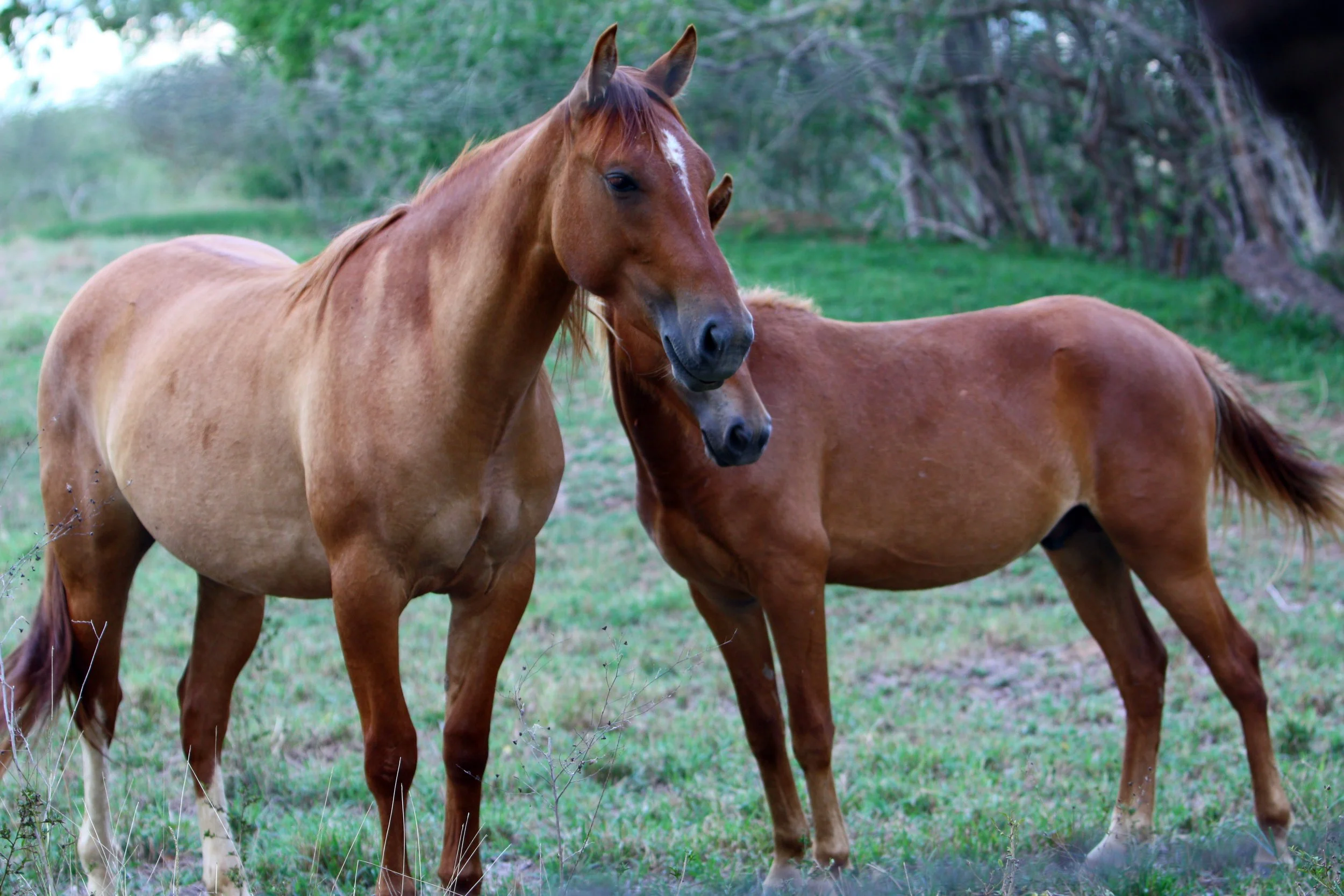
Photo by Spike Stitch
Licking and Chewing: Now What?
By Désirée Braganza, EdD, EBQ
Spend enough time around horses and you’ll eventually hear someone say, “There. See? She’s processing.”
The horse has just licked and chewed.
For decades, licking and chewing has been described as evidence that a horse has accepted a lesson, is thinking things through or has reached some kind of emotional release. It’s one of those ideas that has become so familiar it almost feels like fact.
But an obvious question follows:
Where is the evidence?
Despite how widely this interpretation is repeated, there does not currently appear to be peer-reviewed research demonstrating that licking and chewing is a reliable indicator that a horse is processing information or has learned something. Learning is generally evaluated by changes in future behavior, not by a single fleeting behavior observed in the moment (McGreevy & McLean, Equitation Science).
That doesn’t mean licking and chewing is meaningless.
It means there is good reason to be cautious about assigning it a single meaning.
One of the central lessons of ethology is that the same behavior can serve different functions in different contexts. A tail swish is not always irritation. Ears pinned back are not always aggression. Yawning is not always a sign of fatigue.
Why should licking and chewing be any different?
Horses display oral behaviors in many different situations. They may occur as arousal changes, after physical exertion, during moments of uncertainty or when a horse experiences conflicting motivations. Ethologists have long described displacement behaviors as actions that can emerge when an animal is caught between competing motivations or emotional tension (Tinbergen, 1952). Licking and chewing may sometimes be part of that picture.
There is also a straightforward physiological explanation worth considering.
When a horse experiences something stressful, threatening, or highly arousing, the familiar "fight, flight, freeze, fiddle, etc." response of the sympathetic nervous system becomes more active. One of its many effects is a reduction in watery saliva production. Humans recognize the same phenomenon as having a "dry mouth" before giving a speech or taking an exam.
As the situation resolves and the horse shifts back toward parasympathetic (“rest and digest”) activity, saliva production increases again. Swallowing, licking and chewing may simply become more likely as the mouth becomes moist once more.
This interpretation fits many everyday observations. Imagine two horses having a brief social disagreement. One threatens, the other yields and the interaction ends. A few seconds later, one or both horses lick and chew. Rather than signaling that either horse has reflected on the encounter, the behavior may simply accompany the return toward a calmer physiological state.
The important word is may.
Not because the science is uncertain about everything, but because a single behavior rarely tells the whole story.
There is another possibility worth considering.
Horses are exceptionally good at learning patterns, including patterns involving people. If a person consistently softens, releases pressure or ends an exercise after seeing a horse lick and chew, a horse may learn that this behavior changes the person’s behavior. In that case, licking and chewing may not be telling us what the horse is thinking. It may simply be part of a learned interaction.
That explanation is consistent with learning theory, although it has not been directly tested.
So where does that leave us?
Not with fewer answers, but with better questions:
What happened just before the licking and chewing?
What happened immediately afterward?
What was a horse’s breathing like? Their posture? Their ears? Their movement? Their expression?
Has this horse shown the same behavior in other situations?
Karen Fenner and colleagues have noted the difficulty of assigning complex emotional or cognitive meaning to isolated behaviors. Behavior does not exist in a vacuum. It gains meaning from the context in which it occurs.
Perhaps that is the real lesson.
The risk isn’t simply misunderstanding licking and chewing.
The greater risk is becoming so certain about the meaning of any single behavior that curiosity disappears.
Ethology invites us to ask different questions. Not, “What does this behavior mean?” but, “What else is happening here?”
The answer may be more complicated than we’ve been led to believe.
It is also far more interesting.
Further Reading
● Fenner, K., et al. (2019). The impact of different human training methods on the horse-human relationship. Animals.
● McGreevy, P., & McLean, A. (2010). Equitation Science. Wiley-Blackwell.
● Tinbergen, N. (1952). Derived Activities: Their Causation, Biological Significance, Origin, and Emancipation during Evolution. Quarterly Review of Biology.
A Note to Readers
Although licking and chewing is often described as a sign that a horse is “processing,” this interpretation does not appear to have been validated by direct scientific research. Licking and chewing may occur in situations involving changes in arousal, stress, conflict, physiological recovery or learned responses to human behavior, but none of these explanations can be inferred from the behavior alone.
If readers are aware of peer-reviewed studies that directly test the “processing” hypothesis, I’d be delighted to read them. Science advances by refining ideas in light of evidence.
Friendly Reminder: These articles are meant to spark thought, not replace expert guidance. Consult equine professionals for individual advice.
Want to reach out to us? Say hello and expect a response.
About the Author
Dr. Désirée Braganza received her equine behaviorist qualifications from the Natural Animal Centre, located in South Africa. As a member of Bodhi Horse Practice, she collaborates with equine professionals worldwide on research projects specific to experiences of domesticated horses from an ethological lens. She is a horse partner, a rider and has cared for and supported numerous horses over the years. Désirée recently relocated from Northern California and is now based in Monroe, Georgia, USA. She consults internationally in person and virtually.
We believe in making ideas freely available, without paywalls. If this article resonates with you and you would like to offer your support so other horses may benefit, feel free to participate in a way that feels true to you.